LABS 4 CHANGE
Social Innovation Labs for the Promotion of Equality, Diversity, and Non-Discrimination in Higher Education Institutions
Co-founded by the European Union, LABS 4 CHANGE is a project from the Erasmus+ program. This project unites renowned organisations from Spain, Greece, and Germany to develop innovative tools and frameworks to address systemic inequalities and enhance inclusive educational practices. Officially launched on September 1st 2024, it will run until 31st August 2026.
Key Project Facts & Target Groups
- 4 partner institutions
- 3 Gender Living Labs established
- 100+ Students actively trained
- 3 European universities transformed
Reimagining Universities as Engines of Equity
Universities aren’t neutral ground. Gender, ethnicity and sexual orientation still shape who feels safe and who gets to participate in higher education, often deepening inequalities that already exist elsewhere.
Why Labs4Change?
Designed to drive real change across university campuses, Labs4Change responds with three connected tools: a qualitative audit tool, social innovation labs embedded on campus, and an interactive online academy that builds the knowledge to use them. Together they aim to make equality, diversity and non-discrimination a working part of everyday university life.
Project Overview
What We Aim to Achieve:
- Generate Knowledge: Produce actionable gender equality knowledge through highly participatory methods.
- Create Space to Act: Build dedicated environments for social innovation and gender-based inclusion inside the institution itself.
- Design Educational Models: Develop frameworks that successfully integrate gender perspectives into higher education.
- Interactive Learning: Host an interactive online academy tailored specifically for university communities.
The Three Pillars of Action
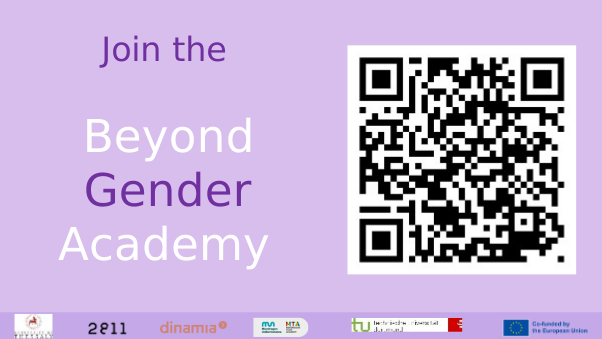
1. Beyond Gender Academy
Power, diversity and belonging in higher education.
Four modules, one transformation. This academy course, available in English, Spanish and Greek, thoroughly examines the intersections of gender, diversity, and inclusion within higher education and broader society. Through critical analysis and hands-on activities, participants gain practical frameworks to embed gender perspectives directly into research, teaching, and community life.
More info and registration here: https://2811global.com/beyond-gender-academy/
2. Mapping Equality
How do university spaces shape who feels welcome, safe, and able to participate?
Mapping Equality is a participatory, qualitative, and intersectional research process combining spatial observation, emotional mapping, and collective reflection. Conceived as both a diagnostic tool and a pedagogical experience, it explores everyday campus environments by utilizing students as co-researchers rather than passive subjects.
The Research Process
- Participatory Design: Students co-create the research tool during the Beyond Gender Academy to ground it in real, lived experience.
- Equality Walk: Based on the concept of Jane’s Walks (Jacobs, 1961), it is a guided campus tour featuring emotional mapping to document comfort, discomfort, and avoidance in specific spaces.
- Collective Reflection: Students discuss spatial patterns with expert mentors, generating qualitative evidence on safety, belonging, and visibility.

5 Dimensions of Equality Analysed
- Visibility & Representation
- Safety & Accessibility
- Communication & Symbolism
- Care & Wellbeing
- Participation & Belonging
This process seeks epistemic justice by validating students’ experiential knowledge, whose findings serve as an empirical basis for the co-design of concrete actions in the subsequent Living Labs phase.
3. Living Labs: How do communities co-create change from within?
The Living Labs are participatory spaces for social innovation embedded within each partner university. They represent the project’s transition from diagnosis to action: taking the findings from the Beyond Gender Academy and Mapping Equality to co-design, prototype, and test real solutions to gender inequality challenges in everyday university life.
Three Phases of Action
- Phase 1: Design & Map: Student driving groups co-design the lab structure, define protocols, and map the local ecosystem of challenges, stakeholders, and potential allies. Transparency, horizontality, and social inclusion guide every decision.
- Phase 2: Explore & Co-create: The driving group engages the community through interviews, focus groups, and co-creation sessions. Collective ideation sessions utilize social design thinking tools like the Impact Matrix to prioritize and pilot the most viable, promising solutions both inside and outside the university.
- Phase 3: Test & Sustain: Pilot results are shared directly with the community to collect feedback and measure impact. Each lab produces an Action Plan and a Sustainability Plan to ensure the lab, its projects, and its culture of change remain active and effective far beyond the project’s lifespan.
Labs4Change Partnership
Coordinated by Mondragon Unibertsitatea – Faculty of Business Studies (Spain) the consortium includes esteemed partners:
- University of Thessaly (Greece): with long achievements in participatory audits and the development of localized strategies for equity.
- TECHNISCHE UNIVERSITÄT DORTMUND (TUDO) (Germany): Leaders in social innovation research and systemic change in their region.
- 2811 Social Enterprise UG (Germany): A consultancy firm specialized in training and empowering change agents.
- DINAMIA S. Coop. Mad. (Spain): A cooperative consultancy firm specializing in social economy and the design of impactful awareness strategies.
LABS 4 CHANGE Aims:
Through a participatory approach, the project aims to:
- Establish Social Innovation Laboratories (Living Labs) within universities to co-create practical solutions for identified challenges.
- Develop an Interactive Online Academy and a webinar series offering training on gender-related topics to university staff, students, and stakeholders.
- Conduct Participatory Audits to identify discriminatory biases and recommend improvements within HEIs.
- Build a Network of Change Agents dedicated to promoting inclusive education across Europe.
Key Outcomes and Impact
By the end of the project, the LABS 4 CHANGE consortium will have achieved:
- The creation of three Social Innovation Laboratories (Living Labs) dedicated to addressing local challenges through co-creation and collaboration.
- Implementation of two pilot audits assessing institutional policies and practices related to gender and diversity.
- Development of ecosystem maps illustrating inequality and inclusion dynamics within universities and their communities.
- Formation of a network of local experts and stakeholders committed to fostering cultural change.
- Accessible resources and training tools that will be available through a Virtual Learning Platform.
Why collaborate with us:
LABS 4 CHANGE offers a unique opportunity for Universities and organizations to create a cooperation network to lead the transition towards more inclusive and equitable educational environments. We actively seek collaborations with HEIs, research centres, and advocacy organisations interested in implementing our tools, sharing best practices, and co-creating solutions tailored to their communities’ specific needs.
This initiative is part of the Erasmus+ Cooperation Partnerships framework, aiming to strengthen the capacity of organisations to operate at the transnational level, enhance the quality and relevance of their activities, and contribute to social innovation across Europe.
Where to find us:
Stay informed about our progress and become part of this transformative project by following us on our official channels:
For more information and collaboration inquiries, contact us at: labs4change@mondragon.edu (Sayuri Alvarado Tanamachi)
You can also reach some of our team members for specific inquiries:
- Academy and webinar series for staff, administration, and students: Malu Landaberea
- Social Innovation labs (Living labs) design and implementation: Karina Maldonado-Mariscal
- Design and implementation of an Audit tool: Ainhoa Pipaon
- Communication and dissemination strategy: Efstathia Kointsanou